
Mission
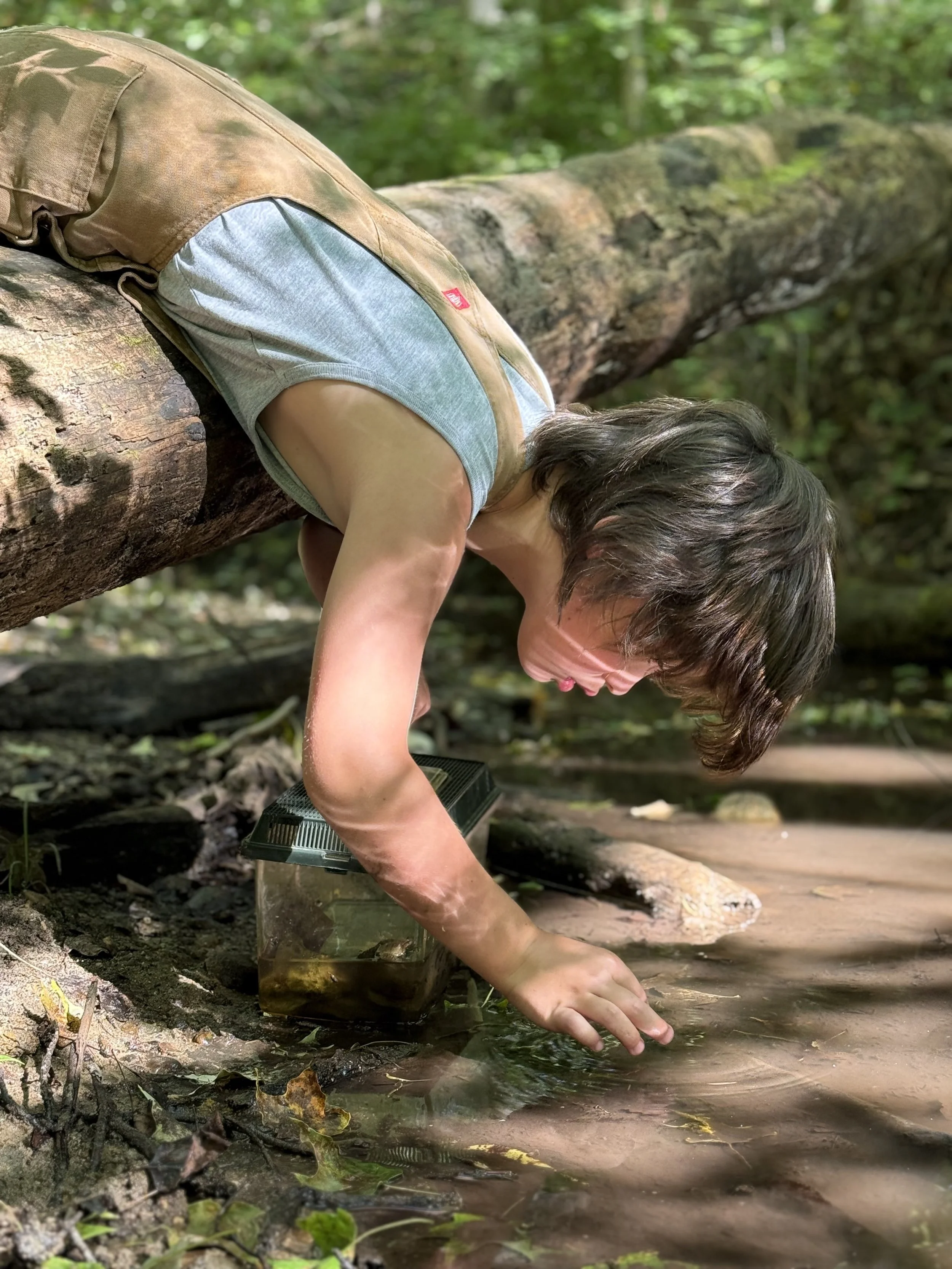
To develop the whole child—mentally, physically, and spiritually, and to promote the development of character. To cultivate a sense of wonder and awe through time and experiences in nature, thereby developing a love for learning and an appreciation for nature and the Creator. To give the child the opportunity to experience an innocent and free childhood through immersion in nature.
Goals
To develop a sense of wonder and awe toward nature that will foster a love and appreciation of the Creator God. This will be done through nature immersion and first-hand experiences with the natural world—through observation, exploration, discovery, play, inquisitiveness, aesthetics, creativity, journaling, questioning, quietness, reflection, and enjoyment in nature.
To give students opportunities to spend considerable amounts of time outdoors in line with research showing the numerous benefits of regular time spent in nature, including academic performance, social development, and self-confidence.
To make education practical. This will be done by providing opportunities for students to engage in useful everyday tasks and to learn to perform practical duties and life skills such as sewing, cooking, survival skills, outdoor work, knitting, gardening, etc.
To promote character development. To develop perseverance, endurance, and courage through direct contact with nature, which will lay the foundation for character development. This will be accomplished through undertaking challenging tasks in nature, such as building a fort, walking on a log across a creek, climbing a tree, navigating a ropes course, enduring cold, rain, and snow, trying new things, taking appropriate risks, and solving problems encountered in the wild. To develop unselfishness, sharing, usefulness, service, and respect as part of character development, the student will be given tasks and responsibilities to fulfill, such as maintaining an outdoor garden and school grounds, helping other students and the teacher, and cooperative teamwork.
To increase motivation, self-esteem, and concentration, as well as curiosity and creativity based on research findings regarding exposure to nature.
To develop respect for the natural world and to help the students view themselves as caretakers of God’s creation.
Read more about The Forest School Way here.
About Us
Cottage Forest School is a multi-grade K-8 private Christian school offering a full academic program as well as regular, ongoing nature immersion experiences that foster holistic growth, the love of learning, and character development.
Based on research, developmental principles, biblical principles, and the Forest School model in Europe, Cottage Forest School seeks to provide a balanced education for the child intellectually, physically, and spiritually.
This includes not only academics, but also time for the students to immerse themselves in nature for significant periods each day. Our curriculum embodies God’s two great books, nature and Scripture, as foundational to all learning. We embrace a holistic education that includes academics as well as other aspects of the child. Special emphasis is placed on Grades K-2 in fostering a well-rounded education that is play-based, nature-based, and scripture-based in a homelike environment.
Cottage Forest School is located at Camp Betz on sixty-three acres on a lake, surrounded by forest, where teachers guide students through nature encounters that help develop a greater understanding of themselves and of the surrounding world.
Read more about our Team/Forest Family here.
“The only schoolroom for children eight to ten years of age should be in the open air. . . . And their only textbook should be the treasures of nature.”
— Fundamentals of Christian Education p. 21
